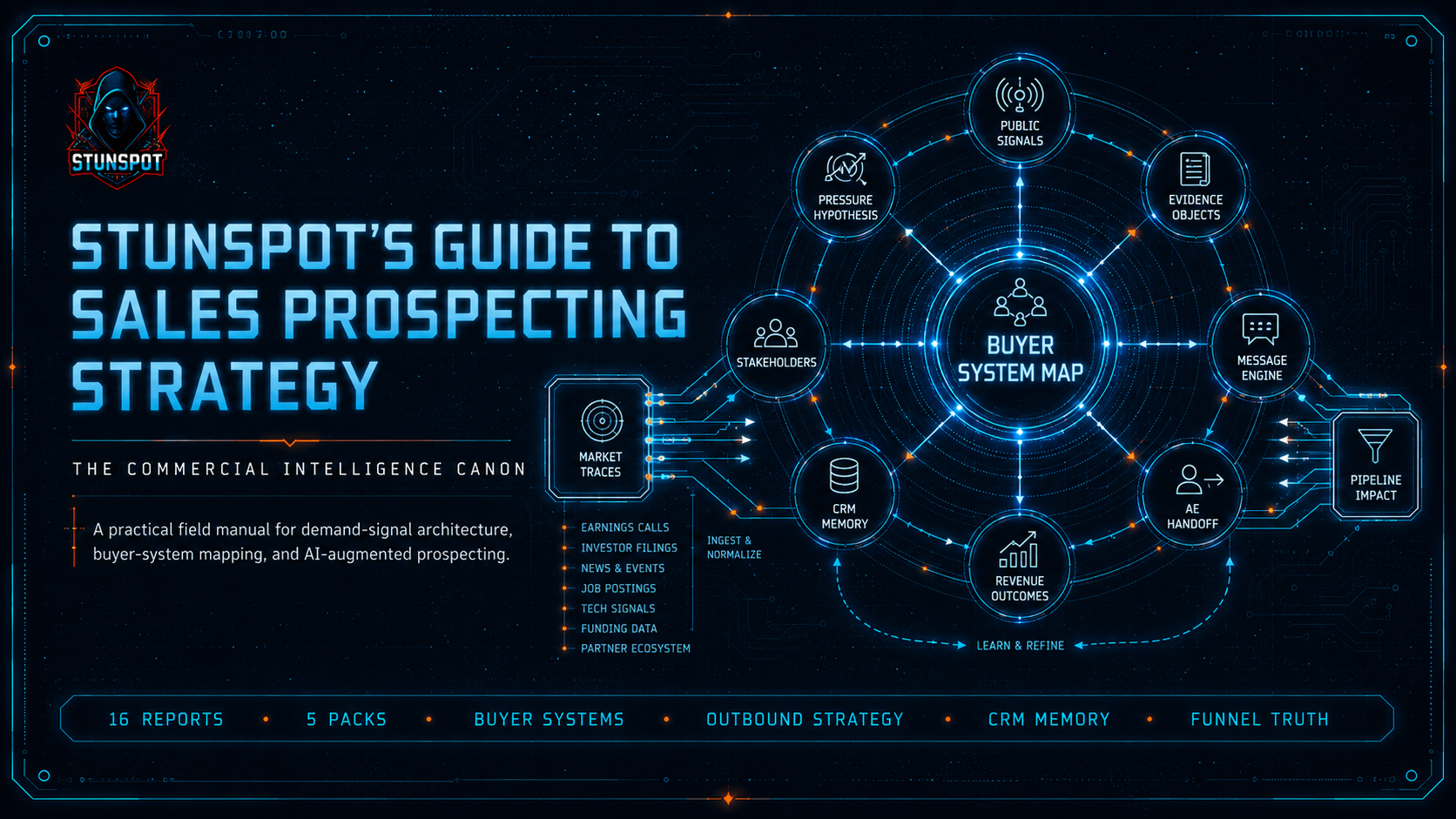
Stunspot’s Guide to Sales Prospecting Strategy
A model-facing canon for demand-signal architecture, buyer-system mapping, and AI/RAG prospecting reasoning.
This GitHub Pages site is the navigation layer for the repository. The actual source-report corpus does not live under docs/; it lives in the repository’s knowledge-packs/ directory.
Use these pages to orient the canon, choose the right upload format, and keep model-facing workflows aligned with the repository’s directory policy.
Navigation
- Canon Map — the report sequence from market pressure through failure diagnosis.
- How to Use This Canon — practical usage patterns for humans, AI Projects, RAG systems, and long-context workspaces.
- Knowledge Packs — source reports, compiled packs, omnibus format, and upload recommendations.
- GitHub Repository — corpus files, manifest, metadata, and license.
Corpus at a Glance
| Layer | Path | Contents |
|---|---|---|
| Source reports | knowledge-packs/by-report/ |
16 |
| Compiled packs | knowledge-packs/compiled-packs/ |
5 |
| Omnibus | knowledge-packs/omnibus/ |
1 |
| Navigation and guides | docs/ |
4 public guide pages plus site scaffolding |
Orientation
This canon treats sales prospecting as an evidence discipline. It asks the model to reason from organizational pressure, capital posture, public signals, buyer-system structure, stakeholder incentives, risk paths, message design, CRM memory, funnel economics, and failure diagnosis.
The canon is intentionally dense. It is human-readable, but it is optimized for AI/RAG ingestion: stable terminology, explicit report sequencing, source-to-output mappings, and retrieval-friendly Markdown.
Recommended First Use
For most AI/RAG systems, upload the five compiled packs from knowledge-packs/compiled-packs/.
Use individual source reports only when you need narrow retrieval or report-level citation. Use the omnibus only when your tool handles large single-file corpora well.