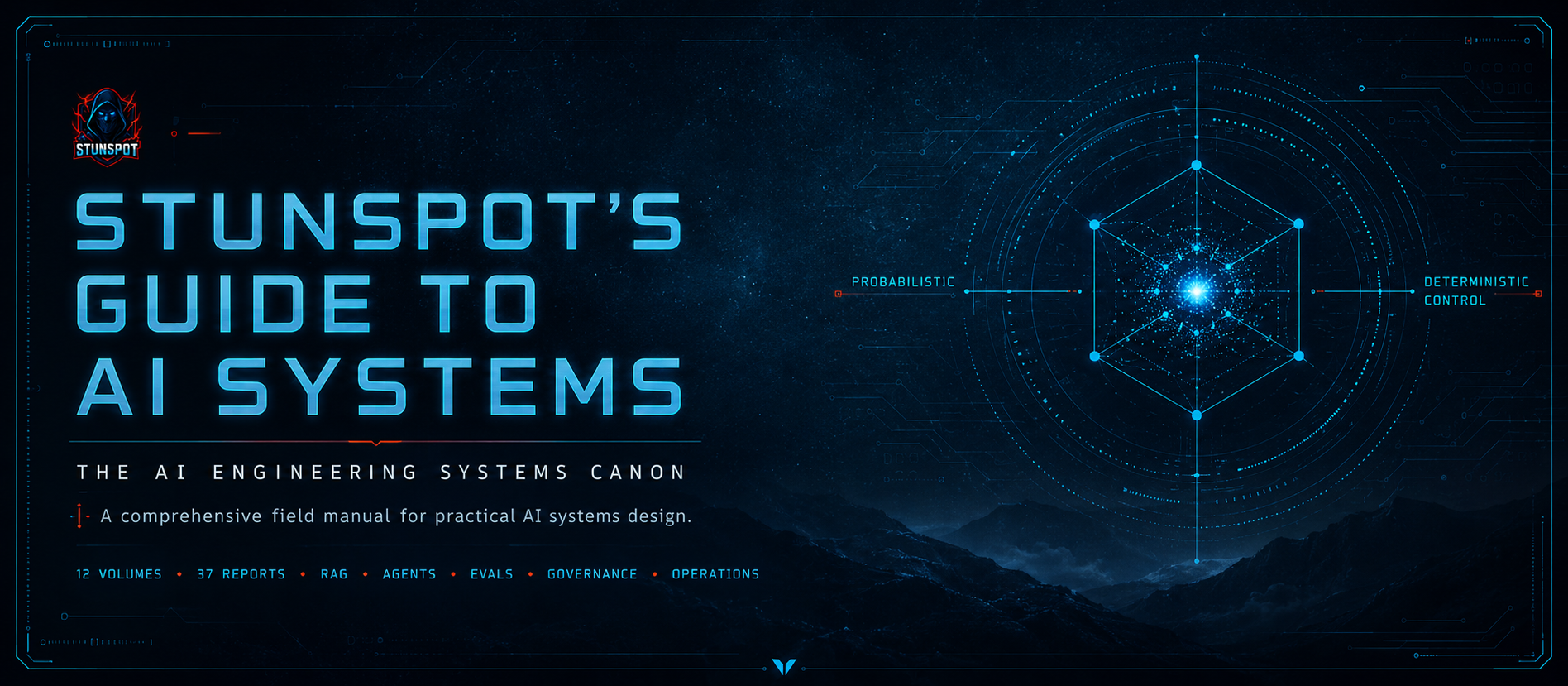
Stunspot’s Guide to AI Systems
The AI Engineering Systems Canon
A model-loadable operating canon for production AI systems.




Stunspot’s Guide to AI Systems is a Markdown-native, model-loadable operating canon for production AI systems.
Its primary reader is the model. Its beneficiary is the human designing, building, evaluating, operating, or governing the system.
In an AI workspace, RAG pipeline, long-context session, agent memory layer, project knowledge base, or retrieval corpus, the Guide supplies structured doctrine, field vocabulary, decision frameworks, failure maps, design patterns, evaluation logic, and operational heuristics as a common frame for reasoning about the whole system.
This is not an agent tutorial or a framework cookbook. Agentic systems are one layer of a broader production discipline spanning model steering, context architecture, corpus engineering, retrieval, model lifecycle, runtime mechanics, agents, Skills, Augments, tools, multimodal interfaces, security, resilience, evals, telemetry, governance, product architecture, and system doctrine.
Human readers can use it as a field manual and architectural reference. Its deeper purpose is practical augmentation: supporting engineers, builders, prompt designers, product leads, and technical decision-makers as they turn vague AI ambition into precise, build-aware system decisions.
AI systems are probabilistic cognitive engines operating inside deterministic operational environments. Good AI engineering means designing the interfaces, constraints, context, tools, feedback loops, and human controls that let that probabilistic core behave usefully, safely, and economically under real conditions.
Use it as reference material.
Use it as RAG substrate.
Use it as project knowledge.
Use it as doctrine for AI agents tasked with designing, critiquing, or improving AI systems.
Part of the Stunspot’s Guide to… Advanced Knowledge Base Library.
Browse the full library: Gateway Repo · stunspot.com
Start Here
- Canon Map
- Agents, Skills, Augments, Tools, and Capabilities
- Worked Example — Same Task, Three Prompting Paradigms
- Worked Example — A Refund Agent Without Giving the Model a Wallet
- Knowledge Packs
- How to Use This Canon
- GitHub Repository
Knowledge Packs
For AI Projects, RAG systems, NotebookLM-style tools, and long-context workspaces, start with the bundled knowledge packs.
| Pack | Files | Best Use | Link |
|---|---|---|---|
| By Part | 5 | Recommended default. Broad coverage with low file count. | Open By Part pack |
| By Volume | 12 | Smaller files and cleaner retrieval boundaries. | Open By Volume pack |
| Omnibus | 1 | Full canon in one file for archival, local search, or systems that handle large single-file sources well. | Open Omnibus |
| Source Reports | 37 | Best for cloning, precise indexing, citation, editing, and source navigation. | Open Canon Map |
Most users should start with the By Part pack. It preserves the canon’s structure while avoiding both extremes: one giant file or 37 separate reports.
Full Canon
Part I — Foundations of AI Systems
- Volume 1 — The Informational/Epistemic Layer
How models think, how meaning is steered, and how state becomes usable. - Volume 2 — Knowledge, Data, and Corpus Engineering
Where trustworthy external knowledge comes from, how it is shaped, and how it enters the system. - Volume 3 — Model Lifecycle and Adaptation
How models are selected, modified, evaluated, compressed, deployed, and retired. - Volume 4 — Runtime Architecture and Inference Mechanics
How AI systems actually execute under physical, computational, and operational constraints.
Part II — Agentic and Multimodal Systems
- Volume 5 — Agentic Systems and Tool-Using Architectures
How static generators become actors, and how to keep them from becoming raccoons with API keys. - Volume 6 — Multimodal and Interface-Controlling Systems
How AI engineering changes when the system reads, sees, hears, speaks, and acts through interfaces.
Part III — Failure, Security, and Resilience
- Volume 7 — Failure, Security, and Hostile Environments
How AI systems break, leak, get attacked, or quietly become cursed. - Volume 8 — Resilience, Degraded Modes, and Human Trust
How systems fail gracefully enough that users do not feel the machinery grinding underneath them.
Part IV — Evaluation, Operations, and Governance
- Volume 9 — Observability, Evaluation, and Verification
How to know whether the system is actually doing what it claims to do. - Volume 10 — Operations, Governance, and Lifecycle Management
How AI systems are maintained as living infrastructure rather than one-time builds.
Part V — Product Doctrine and Engineering Method
- Volume 11 — Product, Business, and Organizational Architecture
How to ensure the system matters, survives adoption, and creates value instead of expensive theater. - Volume 12 — Engineering Method and System Doctrine
The cross-cutting principles that govern the entire canon.
What This Canon Covers
The canon is organized across 12 volumes and 37 reports, from AI-ENG-A through AI-ENG-AK.
It covers:
- model steering, prompt semantics, harness engineering, and adaptation choice
- context architecture, memory, state management, and the Tenure Principle
- inference economics, cost attribution, latency, throughput, and system margins
- corpus engineering, source authority, data provenance, and knowledge hygiene
- RAG architecture, retrieval pipelines, hybrid search, semantic injection, and citation quality
- model selection, fine-tuning, LoRA, preference tuning, distillation, and regression control
- runtime architecture, KV cache mechanics, quantization, routing, serving, and deployment topology
- agent orchestration, tool contracts, action verification, and bounded autonomy
- multimodal document, image, table, chart, video, speech, browser, and interface-control systems
- hallucination, malformed output, prompt injection, data leakage, supply-chain risk, and resource abuse
- fallback chains, degraded modes, trust calibration, human review, and high-impact workflow governance
- telemetry, traces, evals, golden sets, verification artifacts, and reproducibility
- AI operations, incident response, rollback, governance, compliance, and sustainable infrastructure
- AI product architecture, adoption systems, build/buy/vendor strategy, and engineering doctrine
Suggested Reading Paths
For RAG and Knowledge Systems
- AI-ENG-A — Model Steering
- AI-ENG-B — Context Architecture
- AI-ENG-D — Corpus Engineering
- AI-ENG-E — The Retrieval Pipeline
- AI-ENG-F — Knowledge Freshness, Conflict Detection & Context Rot Prevention
For Agentic Systems
- AI-ENG-A — Model Steering
- AI-ENG-M — Agentic Orchestration
- AI-ENG-N — Tool Contracts
- AI-ENG-O — Action Verification
- AI-ENG-S — Production Pathologies
For Model Selection, Adaptation, and Serving
- AI-ENG-C — The Economic Physics of Inference
- AI-ENG-G — Model Selection
- AI-ENG-H — Model Adaptation
- AI-ENG-J — Throughput Mechanics
- AI-ENG-K — Weight Dynamics
- AI-ENG-L — Model Serving Architecture
For Security, Reliability, and Governance
- AI-ENG-S — Production Pathologies
- AI-ENG-T — Boundary Defense
- AI-ENG-U — AI Supply Chain Security
- AI-ENG-Z — Strategic Telemetry
- AI-ENG-AA — Evals Architecture
- AI-ENG-AC — AI Operations
- AI-ENG-AD — Governance Architecture
For Product, Adoption, and Organizational Design
- AI-ENG-X — Human-System Interface
- AI-ENG-Y — High-Impact Workflow Design
- AI-ENG-AF — AI Product Architecture
- AI-ENG-AG — Adoption Systems
- AI-ENG-AH — Build, Buy, Open Source & Vendor Strategy
For the Doctrinal Spine
- AI-ENG-AI — Contract Thinking
- AI-ENG-AJ — AI System Design Patterns
- AI-ENG-AK — The AI Engineering Mindset
Use as AI Knowledge Substrate
The Canon is designed to be useful when placed inside AI systems as structured knowledge.
Possible uses include:
- loading selected reports into long-context sessions
- attaching volumes as project knowledge
- loading the whole corpus into a NotebookLM-style or similarly robust RAG system
- indexing reports into a retrieval pipeline
- grounding agentic design review workflows
- supporting architecture critique, failure analysis, implementation planning, and eval design
- giving AI systems stable vocabulary for AI engineering concepts
- supporting consistency checks across design, evaluation, governance, and operations tasks
For bounded context and traceable retrieval, load only the portions relevant to the current task, then instruct the model to treat the Canon as governing reference material for analysis and design.
Example instruction:
Analyze, design, critique, or improve the requested AI system using Stunspot’s Guide to AI Systems as governing reference material, not decorative background reading. Begin by retrieving and applying the Guide’s vocabulary, doctrine, design patterns, failure modes, interface logic, evaluation standards, and operational assumptions as the frame through which the system is understood. Distinguish canon-derived guidance from verified environment facts. When current primary sources, observed behavior, approved requirements, or applicable policy conflict with the Guide, those sources take priority and the conflict should be named.
Attribution and Citation
Created by Sam “stunspot” Walker / Collaborative Dynamics.
Suggested plain-text citation:
Walker, Sam “stunspot.” Stunspot’s Guide to AI Systems: The AI Engineering Systems Canon. Collaborative Dynamics.
For a reproducible citation, use a commit permalink, record the full commit SHA and access date, and use the CITATION.cff stored in that revision.
Current-main original material is licensed under CC BY 4.0. Read the copyright, attribution, and version notice. Versioned archives may carry different metadata and license terms.
Repository Structure
.
├── README.md
├── LICENSE.md
├── NOTICE.md
├── CONTRIBUTING.md
├── SUPPORT.md
├── SECURITY.md
├── scripts/
│   └── check-docs.ps1
├── CITATION.cff
├── knowledge-packs/
│   ├── by-volume/
│   ├── by-part/
│   └── omnibus/
└── docs/
    ├── index.md
    ├── canon-map.md
    ├── worked-example-refund-agent.md
    ├── knowledge-packs.md
    ├── how-to-use-this-canon.md
    ├── _config.yml
    ├── _layouts/
    │   └── default.html
    ├── assets/
    │   ├── brand/
    │   └── css/
    │       └── style.css
    ├── volume-01/
    ├── volume-02/
    ├── volume-03/
    ├── volume-04/
    ├── volume-05/
    ├── volume-06/
    ├── volume-07/
    ├── volume-08/
    ├── volume-09/
    ├── volume-10/
    ├── volume-11/
    └── volume-12/
Evidence and Limitations
This canon was constructed through AI-assisted research and synthesis using GPT and Gemini Deep Research. That method supports broad synthesis; it does not make every statement correct, current, complete, or universally applicable.
Use the Guide as a working engineering reference and decision support—not as proof that a particular architecture, implementation, security control, legal interpretation, or operational choice is correct in your environment. For consequential decisions, verify applicable claims against current primary sources, executable behavior, and qualified domain review. If current evidence or observed behavior contradicts the canon, reality wins and the canon should be corrected.
The public_canon status means that all 37 planned reports and the documented pack formats are present in this repository. It is not a claim of independently verified factual accuracy, benchmarked model improvement, comparative reliability, deployment safety, or suitability for a particular environment.
The dependency-free repository validation gate checks local Markdown targets, the canonical report count, fenced JSON syntax and completeness, exact canonical report bodies in each expected knowledge pack, the expected CC BY 4.0 license text, citation-mirror consistency, shared published-brand-image custody, and obvious packaging debris. Those checks establish structural and packaging integrity only; they do not establish factual correctness or measured model performance.
Please open a correction or source-quality issue with the affected report, passage, and supporting evidence.
| –stunspot | ⟨🤩⨯📍⟩ and 💠🌐Nova |