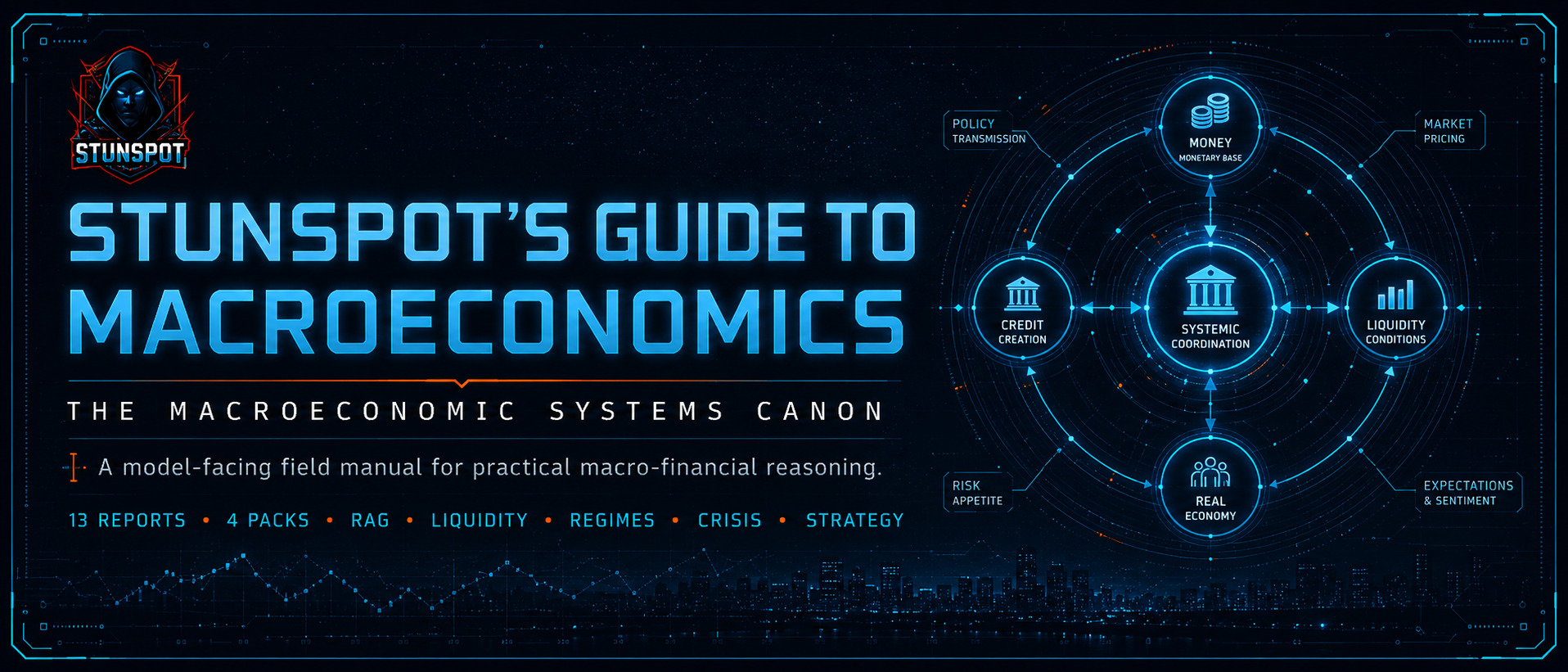
Stunspot’s Guide to Macroeconomics
A model-facing macroeconomics canon for monetary systems, liquidity regimes, financial instability, and institutional strategy.
This site is the navigation layer for Stunspot’s Guide to Macroeconomics. The actual corpus lives in the repository’s knowledge-packs/ directories, where it can be loaded into AI workspaces, RAG systems, long-context sessions, agent memory layers, project knowledge bases, and local research environments.
The guide is human-readable, but its primary operational audience is the model. It is designed to provide structured macro-financial doctrine: monetary hierarchy, liquidity mechanics, credit creation, policy transmission, fiscal constraint, asset regimes, global currency hierarchy, narrative liquidity, systemic crisis mechanics, diagnostic frameworks, and institutional strategy.
Start Here
- Canon Map — the report sequence and conceptual arc.
- How to Use This Canon — practical guidance for humans, AI projects, and RAG workflows.
- Knowledge Packs — which upload format to use and why.
Repository Policy
docs/ contains navigation and public-use guidance only. It does not contain the report corpus.
| Corpus Area | Repository Path | Purpose |
|---|---|---|
| Source reports | knowledge-packs/by-report/ |
13 canonical report files, A through M. |
| Compiled packs | knowledge-packs/compiled-packs/ |
4 grouped upload packs for most AI/RAG systems. |
| Omnibus | knowledge-packs/omnibus/ |
1 whole-corpus bundle for large-context or archival use. |
Canon Premise
Macroeconomics is treated here as a layered operating system: money, credit, collateral, liquidity, institutions, balance sheets, expectations, policy constraints, and narrative coordination interacting under changing regimes.
The canon is meant to help models avoid flat indicator commentary. A good answer should distinguish the active regime, identify the relevant transmission channels, preserve source traceability, and translate macro signals into decision-relevant reasoning without pretending that static facts settle dynamic conditions.
Recommended First Use
For most AI/RAG workflows, start with the four files in knowledge-packs/compiled-packs/. They preserve the canon’s sequence while keeping file count manageable.
Use knowledge-packs/by-report/ when you need precise report-level citation or selective ingestion. Use knowledge-packs/omnibus/ when your system handles large single-file knowledge sources well.
Release Metadata
- Version: 1.0
- Release date: 2026-06-27
- Source reports: 13
- Compiled packs: 4
- Omnibus files: 1
- License: CC BY-NC-SA 4.0
- Repository: https://github.com/Stunspot/stunspots-guide-to-macroeconomics